Salesforce vs Microsoft Dynamics 365: The Enterprise CRM Showdown
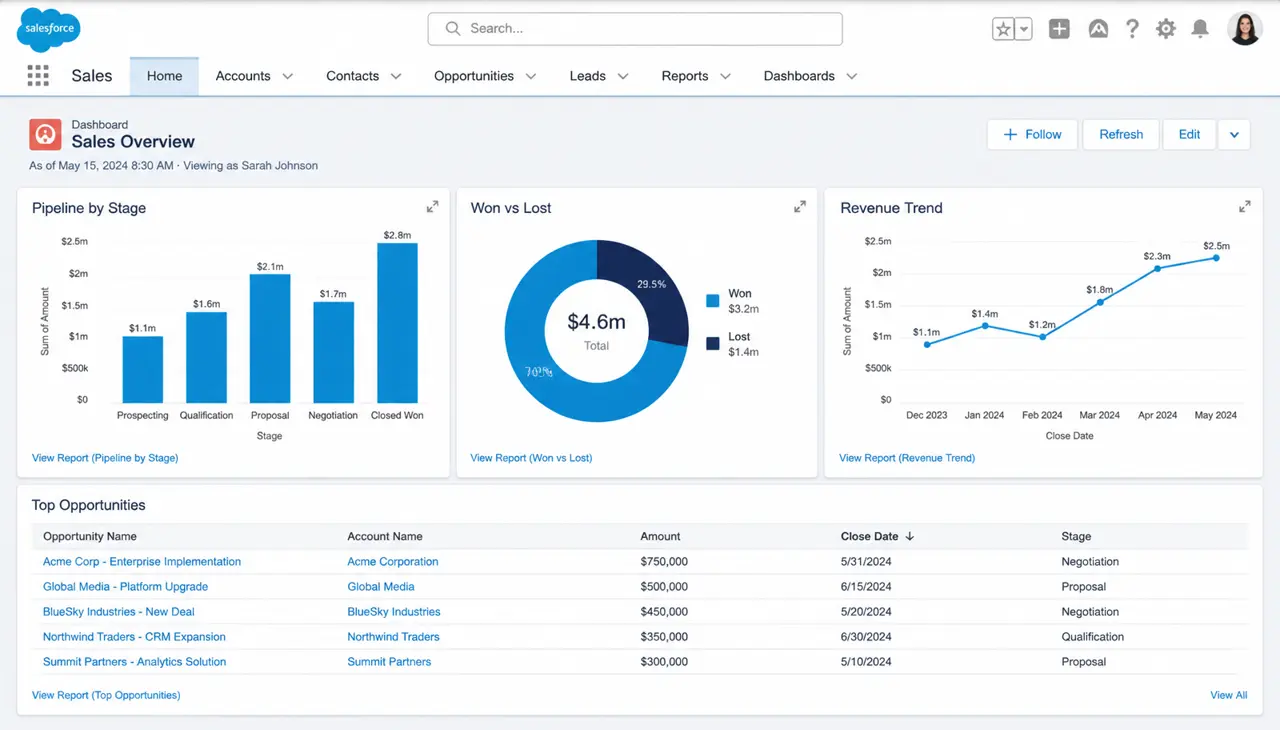
In 2026, the enterprise CRM decision still comes down to two names on most shortlists: Salesforce Sales Cloud and Microsoft Dynamics 365 Sales. Both have matured into sprawling platforms, both now ship agentic AI as a first-class feature, and both will happily quote you a seven-figure annual contract. Choosing between them is less a comparison of feature checklists and more a question of which ecosystem you're already living in, and which one you can operationalize faster.
This guide is the result of running parallel proofs-of-concept for a 3,000-seat manufacturing client over Q1 2026. Same requirements, same data, same eight-week window. What follows are the trade-offs that actually matter at enterprise scale — not the marketing slides.
Platform philosophy
Salesforce is a CRM company that grew into a platform. Dynamics 365 is a platform company that grew into CRM. That distinction still shows up everywhere: Salesforce's out-of-the-box sales workflows are deeper and more opinionated, while Dynamics' strength is how naturally it stitches into the rest of Microsoft — Teams, Outlook, SharePoint, Power BI, and Fabric.
Head-to-head comparison
| Capability | Salesforce Sales Cloud | Dynamics 365 Sales |
|---|---|---|
| Starting enterprise tier | $165/user/mo (Enterprise) | $105/user/mo (Enterprise) |
| Native AI agent | Agentforce | Copilot for Sales |
| Analytics | Tableau + CRM Analytics | Power BI (native) |
| Customization model | Apex + Lightning + Flow | Power Platform + Dataverse |
| Email/calendar depth | Excellent (Einstein Activity) | Excellent (native Outlook) |
| App marketplace | AppExchange (~7,000 apps) | AppSource (~4,000 apps) |
Where Salesforce still leads
Salesforce's advantage in 2026 is depth of vertical clouds and the maturity of its partner ecosystem. If you're in financial services, health, or manufacturing, there's a purpose-built industry cloud with prebuilt data models, compliance controls, and reference implementations. The partner network is also unmatched — for any regulatory or vertical requirement, there's an ISV that has already solved it.
Agentforce, Salesforce's agentic AI layer, has also matured faster than Copilot for Sales in the specific context of pipeline management. Its ability to autonomously draft, review, and act on account plans is genuinely useful for teams with defined playbooks.
Where Dynamics 365 has caught up — or pulled ahead
The Microsoft advantage is licensing and integration gravity. If your org already runs on Microsoft 365 E5, the marginal cost and friction of adding Dynamics 365 is dramatically lower than a Salesforce net-new deployment. Copilot's context flows across Outlook, Teams, and Word — an AE preparing for a call in Teams gets briefing content pulled from the CRM without switching apps.
Total cost of ownership
For a 500-seat deployment with typical add-ons (CPQ, analytics, sandboxes, premier support), our client's three-year TCO landed roughly 22% higher on Salesforce. That gap narrowed considerably once vertical-cloud requirements were factored in — Salesforce's manufacturing cloud replaced two separate third-party tools we would have needed to build on Dynamics.
Implementation reality
Neither is a quick win. Plan on 4–9 months for a serious enterprise rollout with either platform. Salesforce implementations tend to concentrate risk in the declarative-vs-code decision (over-customization creates long-term maintenance debt). Dynamics implementations more often stumble on data — Dataverse modeling done poorly at the start is painful to unwind.
How to choose
- Choose Salesforce if you need a vertical cloud, have a mature RevOps team, or expect heavy third-party ISV usage.
- Choose Dynamics 365 if you're a Microsoft-heavy org, need tight Teams/Outlook flow, or want native Power BI reporting.
- Run a paid 30-day proof of concept on both with your actual data before signing anything.
Is Dynamics 365 cheaper than Salesforce?
Yes, at list price and typically in three-year TCO. The gap narrows when vertical clouds or heavy ISV usage enter the picture.
Can I migrate from Salesforce to Dynamics 365?
Yes, but budget 6–12 months and expect data model rework. Migration tooling has improved but the semantics of Accounts, Contacts, and Opportunities differ enough to require careful mapping.
Which has better AI in 2026?
Agentforce leads for autonomous sales agents; Copilot leads for embedded productivity AI inside Microsoft 365. Neither is objectively better — it depends on the workflow.
Bottom line: both platforms are enterprise-grade in 2026. The right answer is the one that reduces friction for the way your revenue org already works.
Reader reviews
What US professionals said after reading this article.
Marta L.
Director of IT, Regional Logistics Provider · Salt Lake City, UT
Evaluating the TCO for our 250-seat organization became much simpler after seeing the cost breakdown provided here. Most comparisons gloss over the hidden licensing fees that stack up quickly at enterprise scale. We are currently leaning toward the Microsoft side because our internal team already manages our Azure environment. This gave me the data needed for our next board meeting.
Nadia A.
RevOps Manager, Series C Fintech · Syracuse, NY
Our sales team recently tested several AI features to automate lead scoring and follow-ups. Seeing the direct comparison between Salesforce Einstein and Microsoft Copilot helped clarify which engine fits our current data structure better. We found the Einstein insights more aligned with our specific workflow. This analysis saved us weeks of independent research and pilot testing across different departments.
Trevor H.
Head of Engineering, 150-person SaaS Firm · Reno, NV
Building custom internal tools is a priority for us this year. The section regarding Power Platform versus AppExchange offered a clear perspective on which ecosystem provides more flexibility for our developers. We have been stuck in a legacy environment for too long. Identifying the specific integration limitations of each platform is vital before we sign a multi-year enterprise contract this summer.
Xavier A.
VP of Sales, National Insurance Brokerage · Oakland, CA
Managing a large distributed team requires a CRM that handles complex territory management without constant manual intervention. Your breakdown of the 200-plus seat requirements highlighted several licensing nuances I had overlooked in previous vendor discussions. We previously used a smaller CRM that failed to scale with our growth. This guide confirmed that moving to a more robust enterprise solution is necessary.
Wade M.
Chief Technology Officer, Mid-Market Manufacturing · Sacramento, CA
Deciding between these two giants often feels like a toss-up until you look at the long-term support costs. The detailed look at the AppExchange marketplace helped me understand the additional third-party spend we should anticipate if we go the Salesforce route. My department needs to be certain about the total investment. This level of transparency regarding ecosystem costs is rare.
Related articles

CRM Security and Compliance in 2026: What US Buyers Must Verify
 By CRMWorldGuide Editorial • July 8, 2026
CRMs hold your most sensitive customer data. In 2026, security should be as important as features when you buy.
Read More →
ERP vs CRM in 2026: What They Do, Where They Overlap, and Which You Need First
By CRMWorldGuide Editorial • July 8, 2026ERP and CRM are often confused. Here is exactly what each does, how they overlap in 2026, and which one your business needs first.
Read More →