Zoho CRM Review 2026: Pricing, Features, and Real-World Verdict
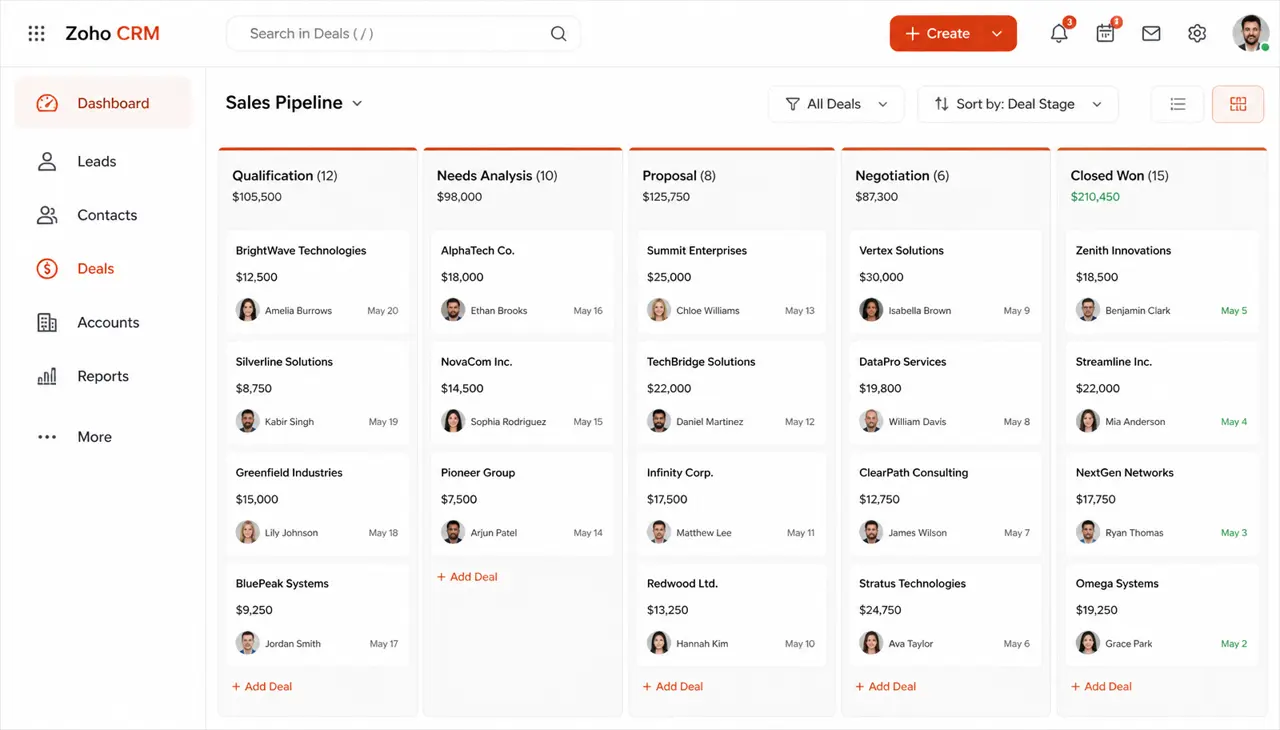
Zoho CRM enters 2026 as a powerhouse of utility and affordability, continuing its long-standing reputation as a credible disruptor to the Salesforce-HubSpot duopoly. For American mid-market businesses and growing enterprises, Zoho is no longer just the 'budget' alternative; it has evolved into a sophisticated, AI-first ecosystem that addresses the core friction points of modern sales cycles. In this review, we examine the current state of Zoho CRM, focusing on its recent architectural updates, the maturation of its Zia AI assistant, and how its pricing model holds up against a landscape shifting toward usage-based costs. Whether you are migrating from a spreadsheet or scaling a global sales team, understanding Zoho’s unique integration within the broader Zoho One suite is essential for determining if this platform can serve as your single source of truth.
Zoho CRM Pricing: Transparency in a Complex Market
One of Zoho’s most enduring advantages is its transparent, tiered pricing model. While competitors often hide behind 'Contact Sales' gates, Zoho remains refreshing in its clarity. In 2026, the platform has maintained a competitive edge by bundling more advanced features into lower tiers than its peers. However, the true value proposition is often found in Zoho One, which provides access to over 45 applications for a slightly higher per-user cost. For those strictly looking for CRM functionality, the Professional and Enterprise tiers remain the 'sweet spot' for most US-based B2B firms. Below is the current 2026 pricing schedule for annual billing cycles.
| Plan Tier | Per User / Month (Billed Annually) | Key Feature Highlights |
|---|---|---|
| Standard | $14 | Automated Workflows, Custom Dashboards, Scoring Rules, Mass Email |
| Professional | $23 | Blueprint (Process Manager), Inventory Management, Web-to-Case, SalesSignals |
| Enterprise | $40 | Zia AI, Canvas Design Studio, CommandCenter, Multi-user Portals, Advanced Customization |
| Ultimate | $52 | Advanced BI (Zoho Analytics), Enhanced Storage & Feature Limits, Enterprise-grade Sandbox |
What Zoho CRM Does Well: The 2026 Strengths
Zoho thrives on its ability to provide high-level customization without the exorbitant consulting fees typically associated with enterprise-grade software. The Canvas design studio, for instance, allows administrators to drag and drop elements to create a UI that actually matches the specific workflow of their sales reps, rather than forcing them into a rigid, legacy grid. Furthermore, Zia, the built-in AI assistant, has moved beyond simple data entry into predictive sales forecasting and anomaly detection. It can now identify when a deal is likely to stall based on historical communication patterns, allowing managers to intervene before the quarter ends.
- Hyper-Customization with Canvas: A drag-and-drop interface builder that eliminates the cluttered feel of traditional CRMs.
- Zia AI Insights: Predictive lead scoring and 'best time to contact' suggestions that actually improve conversion rates over time.
- Blueprint Process Enforcement: A robust workflow builder that ensures every salesperson follows the exact same qualification and closing steps.
- Omnichannel Communication: Native integration with email, telephony, social media, and live chat within a single lead record.
- Advanced Analytics: Built-in business intelligence that allows for complex cohort analysis and churn prediction without third-party add-ons.
Trade-offs and Potential Weaknesses
No software is without its flaws, and Zoho's largest hurdle remains its sprawling, sometimes fragmented user experience. When you move outside the core CRM and into the wider Zoho One universe, the consistency of the UI can falter. Furthermore, while the platform is highly customizable, the initial setup can feel overwhelming for small teams without a dedicated IT lead or a qualified Zoho partner. There is a steeper learning curve associated with the 'Blueprint' and 'Deluge' scripting language compared to the simplistic, plug-and-play nature of HubSpot. US businesses should also note that premium support often carries an additional cost if you require 24/7 immediate phone access.
- Interface Fragmentation: Navigating between different Zoho apps (Finance, Projects, CRM) can feel like switching between different eras of design.
- Complex Initial Setup: The sheer volume of toggles and settings can lead to 'choice paralysis' for novice users.
- Deluge Scripting: While powerful for automation, it requires a basic understanding of coding logic for complex customizations.
- Premium Support Surcharge: While standard support is included, the 'Enterprise' level of hand-holding requires a separate percentage-based fee.
The Ecosystem and Integrations
Zoho CRM is the centerpiece of a massive ecosystem, but it plays surprisingly well with others. For 2026, Zoho has doubled down on its 'North American First' strategy, ensuring deep, bi-directional syncs with the tech stacks most common in US enterprises. This includes native extensions for Microsoft 365, Google Workspace, Slack, and Zoom. For marketing automation, while Zoho Campaigns is the native choice, the CRM offers robust triggers for Marketo and Mailchimp. Developers will appreciate the well-documented REST APIs and the Zoho Marketplace, which features over 1,000 pre-built integrations for everything from digital signature tools like DocuSign to specialized financial gateways like Stripe and QuickBooks Online.
The true power of Zoho doesn't lie in its isolated features, but in its ability to bridge the gap between sales, marketing, and finance without the 'integration tax' associated with larger competitors.
Who is Zoho CRM For?
Zoho CRM is the ideal choice for businesses that have outgrown the 'freemium' limitations of HubSpot but find the licensing and implementation costs of Salesforce prohibitive. It is particularly well-suited for manufacturing, professional services, and high-volume B2B sales teams that require rigorous process enforcement. Because of its modular nature, it scales excellently from a 10-person boutique agency to a 500-person enterprise. If your organization relies heavily on diverse lead sources—such as webinars, social media, and trade shows—Zoho’s omnichannel tracking provides a level of granularity that helps marketing departments justify their spend through clear ROI attribution.
Competitive Comparison: Zoho vs. the Giants
| Feature | Zoho CRM | HubSpot | Salesforce |
|---|---|---|---|
| Price Flexibility | High (Low per-user cost) | Low (Expensive scaling) | Medium (Complex contracts) |
| Ease of Use | Moderate | Excellent | Low (High training needed) |
| AI Capability | Zia (Included) | Breeze (Add-on/Tiered) | Einstein (High cost) |
| Customization | Very High | Moderate | Infinite (but complex) |
Frequently Asked Questions
How does Zoho CRM compare to HubSpot for small businesses in 2026?
HubSpot offers a more intuitive interface for very small teams, but Zoho provides far more 'power features' like inventory management and advanced automation in its lower-priced tiers. As businesses scale past 15 users, Zoho typically becomes significantly more cost-effective than HubSpot's Professional and Enterprise suites.
Is Zia AI actually useful or just marketing hype?
Zia is highly functional in 2026. It excels at sentiment analysis in emails, alerting reps when a lead sounds frustrated, and it provides accurate 'next-best-step' recommendations. Unlike some AI tools, most of Zia's core features are included in the Enterprise tier without an additional monthly surcharge.
Can I use Zoho CRM without adopting the rest of the Zoho suite?
Absolutely. While Zoho CRM is optimized for the Zoho ecosystem, it functions perfectly well as a standalone tool. It has dedicated connectors for the Google and Microsoft ecosystems, ensuring that your email, calendar, and document storage remain synced regardless of your other software choices.
Does Zoho CRM comply with US data privacy regulations?
Yes, Zoho has invested heavily in security compliances including SOC 2 Type II, GDPR, and HIPAA. For US-based firms in regulated industries like healthcare or finance, Zoho provides robust data encryption, audit logs, and regional data residency options to ensure full compliance with federal and state laws.
What is the implementation timeline for a mid-sized company?
A standard implementation for a 50-person team usually takes 4 to 8 weeks. This includes data migration, setting up Blueprints for sales processes, and training the staff. Companies with very complex legacy data may take longer, but compared to Salesforce's 6-month average, Zoho is much faster.
The 2026 Verdict
Zoho CRM remains a top-tier recommendation for the 2026 calendar year. Its commitment to platform stability, combined with an aggressive feature roadmap that democratizes AI and advanced customization, makes it a formidable tool for any growth-oriented business. While the user interface can occasionally feel overwhelming and the support model for lower tiers could be more responsive, the sheer return on investment is undeniable. For organizations that want enterprise-level functionality without the enterprise-level invoice, Zoho CRM is the most logical choice in the current market. It balances power and price in a way that few other SaaS providers have managed to sustain over the last decade. If you are looking for a platform that will grow with your ambitions while keeping your overhead manageable, Zoho CRM earns our 'Best Value for Enterprise' distinction for 2026.
Reader reviews
What US professionals said after reading this article.
Hugo F.
Director of Field Operations, 15-person regional HVAC group · Minneapolis, MN
Switching our technicians over from a legacy spreadsheet system required a clear cost breakdown. This breakdown of the Standard $14 tier helped me justify the migration to our ownership group. We needed basic lead tracking without the fluff of higher tiers. The article accurately captures how the pricing scales as we add more vans to our fleet this year.
Serena S.
RevOps Lead, Series B supply chain logistics firm · Detroit, MI
Blueprint has become the backbone of our sales process since we scaled to forty reps. Your analysis of the automation features reflects exactly what we experienced during implementation. Most reviews gloss over the workflow complexities, but you covered the transition to Enterprise quite well. It assisted our team in deciding to skip the Pro tier entirely to get those advanced process triggers.
Rachel S.
Founder, Boutique digital design agency · Chattanooga, TN
Managing a creative shop means aesthetics matter as much as data. Your mention of the Canvas design tool was the main reason I kept reading. We currently use a basic CRM but everything looks so clinical. Seeing how we can customize the interface to match our internal brand makes the $23 Pro plan feel like a bargain for my five-person team.
Simon N.
VP of Sales, 200-employee manufacturing plant · San Diego, CA
Our legacy CRM was costing us double what the Ultimate tier charges. Reading your take on Zia AI convinced me to run a pilot program for our East Coast territory. The predictive forecasting models you described appear robust enough to handle our complex industrial sales cycles. We are looking for a way to centralize communication and this comparison made the choice easier.
Chloe C.
Head of Growth, Multi-state e-commerce distributor · Louisville, KY
Integrating our entire tech stack was our primary goal for the current fiscal quarter. Your section on the Zoho One suite clarified the value of bundling services rather than paying for standalone seats. We were previously juggling different apps for mail and support. Consolidating everything under one umbrella makes more sense for our overhead after seeing these yearly price points listed out.
Related articles

The 7 Best CRM Software Platforms for Small Business in 2026
 By CRMWorldGuide Editorial • July 8, 2026
We tested the seven most popular CRMs for US small businesses and ranked them by price, features, and real ease of use.
Read More →
HubSpot Review 2026: Is It Still Worth the Price?
By CRMWorldGuide Editorial • July 8, 2026HubSpot's pricing keeps climbing. After running it live for a year across three client accounts, here's whether it still delivers.
Read More →
Pipedrive vs HubSpot 2026: Which CRM Fits Your Sales Team?
By CRMWorldGuide Editorial • July 8, 2026Pipedrive is built for salespeople; HubSpot is built for revenue teams. The right pick depends on how your pipeline works.
Read More →